


Brad Blackwood interview: Serving Art
A good mastering engineer helps the art emote while not leaving fingerprints all over the music. Those are Brad Blackwood’s own words, explaining how he views his role in creating great music recordings. He has mastered music for Maroon 5, Alison Krauss, and Lamb of God, earning no less than three Grammy awards and numerous other nominations. His work is in high demand, but he still managed to find some time for an interview with us at Weiss Engineering.
With three Grammy awards and a client list that includes Maroon 5, Black Eyed Peas, Lamb of God, and Alison Krauss, it’s no exaggeration to call Brad Blackwood one of the world’s most prominent mastering engineers.
After finishing his music production studies at Full Sail, he found himself working at the legendary Ardent Studios in Memphis, Tennessee, alongside legendary engineers such as John Fry, John Hampton, and Jim Dickinson. Today, he is working out of his own studio Euphonic Masters, where he has not only mastered some of the most successful albums in recent years, he has also stepped into the world of Dolby Atmos and mastered Atmos releases of classic albums by Fleetwood Mac, Kiss, and Prince.

Brad Blackwood. Photo by Louis Tucker.
Mastering is the final step in creating a music album, the final — but no less critical — touch after recording and mixing. The process is a combination of technology and art. So, how does Brad view his work from these aspects? Is it more art or more technology, or can they not be separated? In which situations is which aspect most important?
“Good question. While mastering is a clearly technical job due to various standards — production, master formats, various types of coding, etc — I think it’s vitally important that we understand that we’re serving art, helping artists achieve their vision regarding how they impact the listener.
While mastering is arguably the least creative of the three aspects of making a recording — tracking, mixing, mastering — my clients aren’t hiring me to handle their music in a robotic or automated manner, they want to hear the tweaks that help their music connect with their fans. In my opinion, a good mastering engineer helps the art emote while not leaving fingerprints all over the music.”
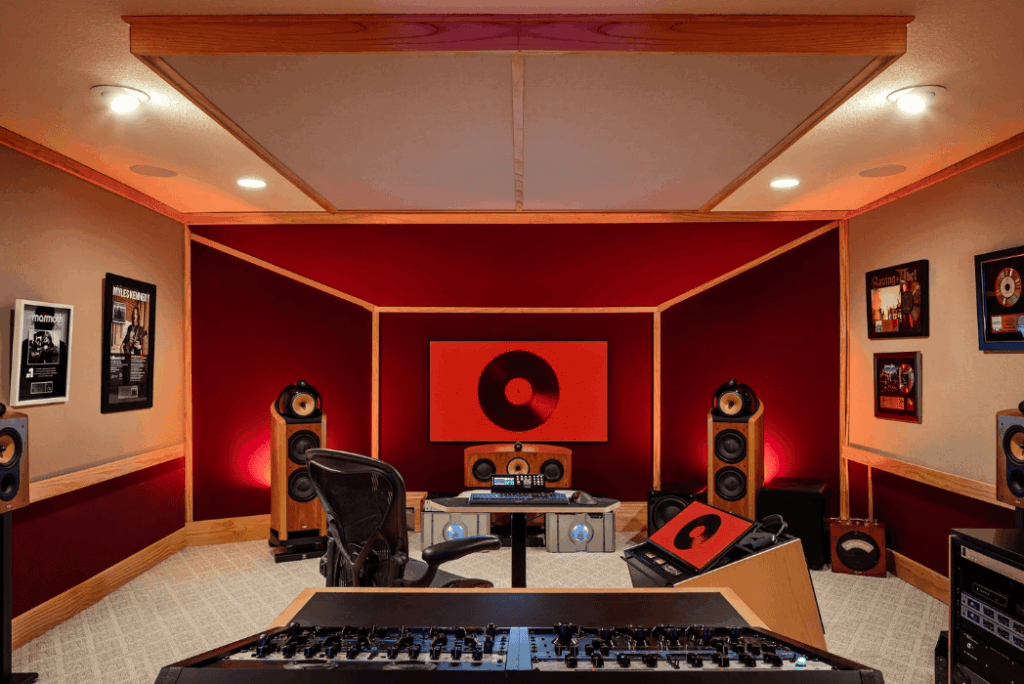
Front view of Euphonic Masters, Brad’s mastering studio. Photo by Andrew Parks.
What does the mastering process typically look like in terms of contact between you, the mix engineer, and the artist? Do you invite those people to sit in with you during mastering, or do you prefer working alone and sending them the results? Do you often get back to the mix engineer with questions and/or suggestions for changes that are better suited to be made in the mix?
“I basically stopped doing attended sessions 18 years ago after spending a year looking at various aspects of sessions — such as the percentage of projects needing revisions — and realizing that while some clients like to attend, more often than not it took the session in a different direction that it would have otherwise. My room sounds amazing, but there’s no such thing as a perfect room or speaker, so every listening space has some anomalies. The beauty of working day in and out in an already great space is that you learn these subtleties and your brain remembers them. So when I work in my space, I know exactly how it will translate, whereas someone hearing the space for the first, or even twenty-first, time won’t know those subtle things. There are occasionally exceptions, typically long time clients that have become friends and who are working on a project that needs some special treatment. But they are rare.
I rarely question mix decisions or offer suggestions unless they are requested. But even then, by the time I get the mix and can begin my work, the artist, engineer, producer, label, management, etc have all signed it off. So unless it’s something egregious or maybe something they simply lacked the monitoring resolution to hear, I assume it’s intentional. I remind people all the time that it’s been almost three decades since I mixed anything, so I’m not one to give mix feedback. I’m happy to tell them what I’m hearing, but telling them how to get there isn’t really my thing.”
Are there any common issues that you often find yourself correcting in mixes? What would you wish mix engineers would stop doing?
“The main things I find myself correcting are simply overall frequency response imbalances that are due to room and/or monitoring issues in the mix space. Thankfully, my clients are almost universally experienced engineers and know what they’re doing, so the corrections aren’t generally severe. It still amazes me today how subtle corrective EQ can radically alter the impact of a song. Many engineers print mixes too loud or print reference mixes that are so loud that it makes mastering the track more difficult than needed. I can get things as loud as you want, but starting off with limited or clipped mixes will directly impact how good it can sound when I’m done. And while the so-called loudness war isn’t over, modern streaming seems to have minimized the need to make overly-loud records — meaning records that sacrifice quality just to be loud.
That said, I’m still asked to cut records pretty loud sometimes. I think it’s as much a matter of old habits dying hard as anything else. Not to mention we now have an entire generation of musicians who have grown up listening to highly limited/clipped/distorted music, so it sounds normal to them.”
Clearly, making the audio translate to various formats and playback situations is a core task of mastering. How much does your process change when new playback devices and delivery media emerge? Case in point — over the last 15 years, we’ve seen Bluetooth speakers (typically mono) replacing traditional stereo hi-fi systems in many homes and workplaces. And online streaming is likely the most prominent format. Meanwhile, vinyl has also made a comeback. Do such changes impact your work and the decisions you make regarding mastering? If so, what do you do differently today compared to 15-20 years ago?
“Ultimately, mastering music that will translate as well as possible on various playback systems comes down to getting the overall balances right, meaning frequency response and energy density. When you get the mixes dialed-in to where they are really well-balanced — my definition of which isn’t mathematical, it’s simply what feels right to me — they tend to translate equally well on big hifi rigs, car stereos, ear buds, or mono bluetooth speakers playing back lossy codecs.
Vinyl is fun, and while the sales numbers are strong, it’s never going to replace the loss of CD sales. I like vinyl, but I also understand the media’s limitations. It’s always going to be noisier with limited frequency response, more crosstalk etc. But understanding some of the limitations means that I’m better able to prepare masters for vinyl — less limiting, watching the stereo width, keeping an eye on the spittiness on the top end, etc. There are some great guys cutting vinyl masters out there, but there are also guys who will really mess up a master if it’s too essy. So yes, it’s a different approach mastering for eventual vinyl vs digital/streaming.”
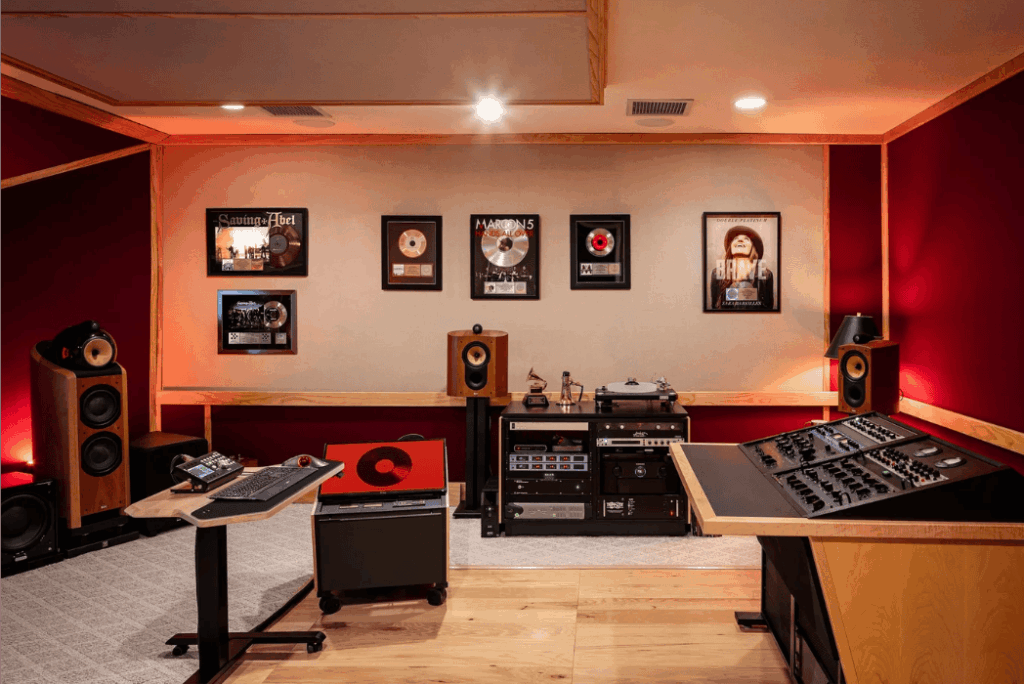
Side view of Brad Blackwood’s control room. Note the Weiss DAC-1 MK3 in the top left position in the rack. Photo by Andrew Parks.
Speaking of new formats emerging, what are your thoughts on immersive audio for music? Do you like it as a music listener, do you enjoy working with it, did you feel its emergence meant a significant change for you as a mastering engineer? Do you think immersive for music will become a widely accepted consumer format?
“Atmos mastering has been a real joy for me. It’s odd that labels in particular have pushed the idea that mastering Atmos mixes isn’t necessary — I’ve even heard some mastering engineers repeat this. I expect it stems from an effort to save money, both the labels and the mastering engineers. Atmos isn’t cheap, getting into the game is expensive if it’s done well, but the results can be truly breathtaking. Atmos is also an example of where translation is key. You have, at a minimum, six times the number of speakers as you do in a stereo mix, with various fold-down mixes being derived from the format. I’ve really enjoyed working on both classic albums and new releases in the format. Between the labels and the streaming platforms — primarily Apple — I think we’ll see wide spread acceptance of the format in the next few years. It wouldn’t surprise me at all if we find Apple demanding all uploads being ADM masters (the Atmos master file format) or similar at some point.
Regardless, I suspect we’re only a few years away at most from being at a point where most of the music people stream will be immersive, whether that be for a 7.1.4 speaker setup or a 2.0 downmix for stereo.”
How much has loudness normalization, a standard feature on most (if not all) streaming platforms, affected your work? Do you for example master with greater dynamics and larger low end than you were able to before loudness normalization was a common thing? Have the client requests changed since loudness normalization became a thing?
“It’s not really affected it at all. I’ve made it a point to not try to chase platform’s numbers as they can — and have — changed arbitrarily. And really, it’s about making the music move people. I’ve had a few clients request specific LUFS levels as they read some of the silliness about it online, but in nearly every case they came back and requested I cut it a bit louder as they didn’t like the way the music sounded outside of the streaming services. The reality is that if you master it to sound good, it will sound good, even if it’s normalized one way or the other.”
You work with artists in a variety of genres —from bluegrass to metal. Do you approach the mastering work differently depending on the genre and style? Or are the objectives with your work generally the same?
“Yeah, I really love how day to day my workload jumps genres. It really keeps it interesting. That said, the objective is always the same — help the artist achieve their musical goals. The mix will typically tell you where it’s trying to go and most times it just needs a little bit of help to get there. So no, no real difference whether cutting Alison Krauss or Alter Bridge.”
Are there any artists or genres you particularly enjoy working with, or work you are particularly proud of?
“I’ve been really blessed in my career as I’ve had the opportunity to work with amazing artists across multiple genres. I really love rock and metal, that’s kind of where I came from as a music lover from a young age, but I really enjoy acoustic music as well. I truly love music created and performed by people who spent years, decades even, mastering their instrument. There’s just something special about great musicians collaborating that speaks to me.
I’m really proud of the Atmos catalog work I’ve done for Fleetwood Mac, Prince, Kiss, etc. I’m also very proud to have mastered several Alison Krauss albums. Paper Airplane won the Grammy for Best Engineered, Non-Classial. Finally, it’s been really cool to master albums for artists I was a fan of before I ever got into the industry, such as Dave Matthews Band and Everclear.”
Let’s round off with a humble brag! You’re one of the most successful and most hired mastering engineers around — why is that? What is it that sets you apart?
“I really wish I knew. It’s crazy enough to me that I get paid to listen to music all day, but working with the amazing artists I get to is insane to me. I do believe that beginning my career working at a highly successful studio complex surrounded by amazing engineers had a massive impact on how I listen and view my role. Listening and working alongside engineering legends like Jim Gaines, John Fry, John Hampton, and Joe Hardy while at Ardent had a massive impact on my career. These guys had mixed more hit records than I had hot meals, and their impact cannot be understated. They taught me how to listen but also how to interface with artists and make them comfortable. Beyond that, I think two things have helped me forge a successful career. First the ability to walk the line between understanding the tech and artist’s intention. Understanding the technology we use is vitally important, but we cannot lose sight of the goal, which is emotional impact. Sometimes technical perfection isn’t what serves the music, and understanding that balance is key. Second, understanding that this is a service industry where you’re only as good as your last client is vital. I waited tables for a bit in college, which taught me a lot about how to make someone feel welcome and wanted. If we as engineers can leave our egos at the door and do whatever it takes to help the artist, we’ll get better results, and my goal is to make each client feel like they’re important to me. Because they are, regardless as to whether they sell 10 copies or 10 million.”